back

pewpew

from capo to chaos

vst beta

Open beta, free while it runs. Drop a name and email and the build's yours.

latest 0.8.0 2026-07-27
full changelog ↓
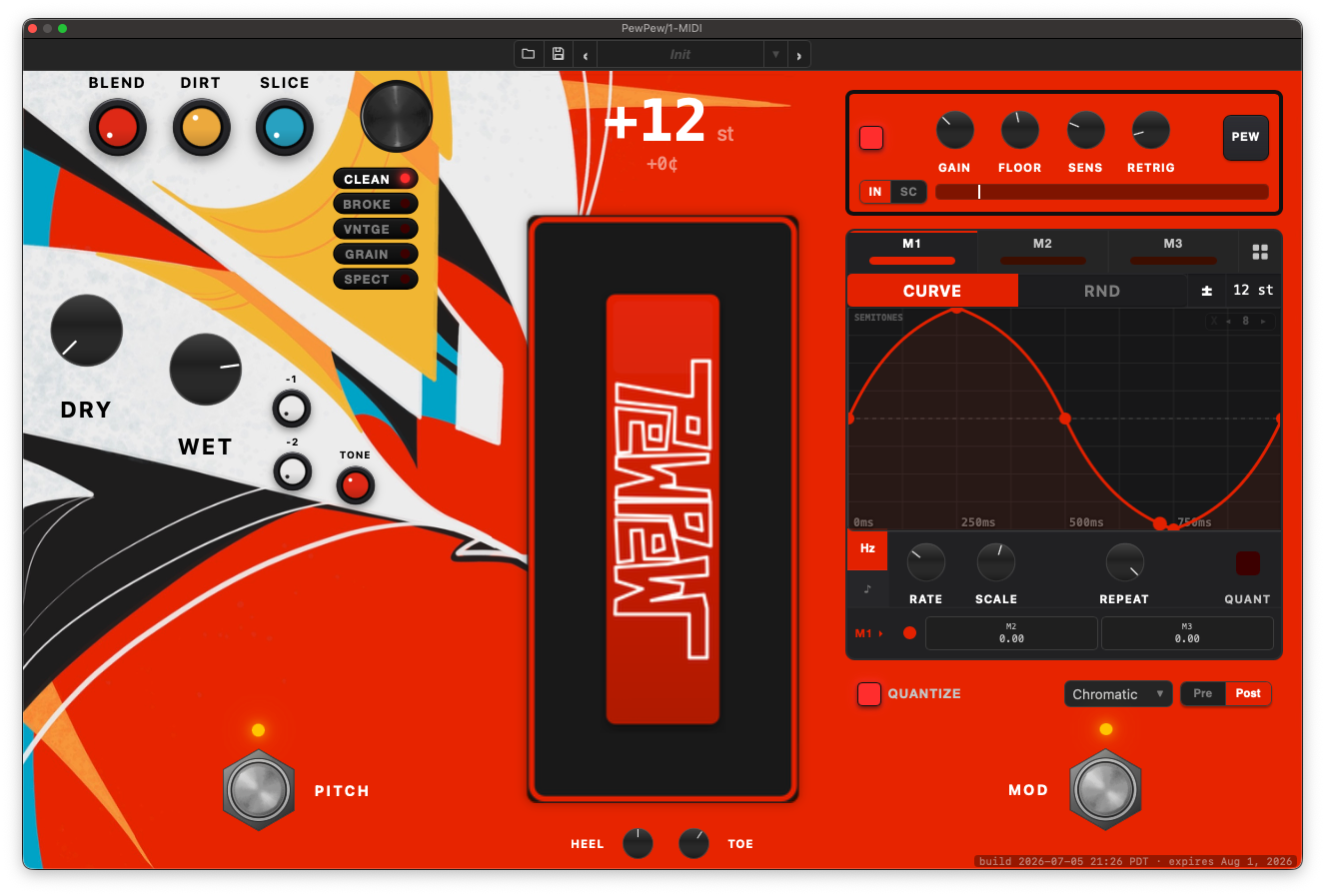
PewPew plugin UI
// features

PewPew is the ultimate real-time pitch shifter built to be played with a guitar or bass. It covers every way to shift pitch that holds up in real time, each as fast and clean as the technique itself allows.

Six pitch-shifting algorithms
  • Analog-style octave divider layering
  • Clean PSOLA / WSOLA
  • Broken early-whammy style
  • Vintage dual-delay buffer crossfading
  • Granular pitch
  • Spectral phase vocoder + sine resynthesis
A deep modulation matrix
  • User-drawable LFO / ENV shapes, free-running or synced to your DAW tempo
  • S&H randomness generators
  • Cross-modulation routing, with per-slot polarity, depth, and slew
  • Pitch quantization into musical scales
Built to be played
  • As low latency as each pitch algorithm allows, for tight tracking
  • Tuneable transient triggering so you can "play" your modulation (directly and sidechained)
  • Independent heel and toe settings across a ±48-semitone range
  • Manual PEW button to fire modulation on demand (also accepts midi triggers)
// beta

PewPew is in an early open beta while development finishes, so expect some jank and expect things to move around before they settle.

Please send me feedback, bugs, and especially any cool presets you make while testing! Come hang out in the discord, or you can reach me directly via email or instagram.

// changelog
0.8.0 2026-07-27

NOTE: This release changes parameters!

Every per-engine knob was given a new internal address, so presets and saved sessions from 0.7.x will load with the engine knobs back at their defaults. Pitch, wet/dry, the pedal range, the subs, the trigger and all modulation settings are unaffected. This is a one-time break done deliberately at a beta version jump boundary.

New

  • Rewrote Spectral from scratch on a phase-gradient heap integration algorithm, replacing the old phase vocoder / sine reconstruction. Chord tracking at low frequencies is much better and transients hold together properly. It is higher latency than the old engine in exchange for substantially better quality shifting. Spectral hits under 25ms flat and upshifted, and passes 35ms when downshifting past an octave.
  • Alongside the new spectral engine are 3 algorithm parameters:
    • Fizz - introduces spectral garbage, particularly messy when playing lower pitched notes
    • Dissolve - adds phase randomization for a smearier textural sound
    • Cull - keeps only the most important harmonics of your signal and discards the rest
  • Clean has a new feedback mode that lets you inject your shifted signal back into the shift path for instant cascading pitch effects. Expect this control to move around a bit as I figure out what works and what doesn't.

Changed

  • Some algorithm controls have been renamed and their positions adjusted slightly for clarity and consistency.
  • The blend parameter has been removed in place of feedback. In theory it shifted the OLA search and replace algorithm from PSOLA to WSOLA but in practice because it was pretty audibly mild and just caused a slight degredation of chord clarity, so it's been removed and defaulted to the best OLA Splice style algorith by default in Clean mode. For a more monophonic sound you still have Broke for classic whammy tones and Vintage for a pure dual delay approach.
0.7.2 2026-07-12

Added

  • SEQ modulation mode: a per-slot step sequencer (up to 16 steps) alongside CURVE and RND. Type a semitone offset per step, with per-step glide (slide) and rests (click a step's number to mute it). Runs on a clock (free Hz or tempo-synced) or advances one step per trigger (Step, in the rate selector). Draw a sequence by dragging across the steps or edit with the keyboard (arrows move/nudge, type a value, wrapping at the ends); an audition tone previews each pitch and a live playhead shows the active step. Includes a randomize button.
0.7.1 2026-07-11

Added

  • MIDI trigger input: any MIDI note fires the trigger, the same as pressing PEW. Runs in parallel with audio detection, so it works in every mode.
  • Sidechain trigger input: an optional second input bus can drive the trigger, picked with the IN/SC toggle.

Changed

  • Reworked the trigger panel. The section now has a labeled TRIGGER on/off, and turning detection off greys only the detection controls (knobs + IN/SC) while the meter and PEW stay live. PEW fires on press instead of release, and flashes once on any MIDI note.
  • Clearer modulation on/off. Each mod slot shows its own on/off square, unused slots read as disabled, and the global MOD footswitch greys the whole section.

Fixed

  • The trigger floor line no longer snaps back when dragged to its minimum, and stays visible at its maximum.
0.7.0 2026-07-07
  • First public beta.